All About AI in NJ Higher Education
On October 22, 2026, I had the opportunity to attend NJEDgeCon Autumn 2026 held at Montclair State University in Montclair, New Jersey. Artificial intelligence, of course, was prominent on the schedule, even more so than at NJEDgeCon’s Spring 2026 event. Here are the key takeaways from the event:

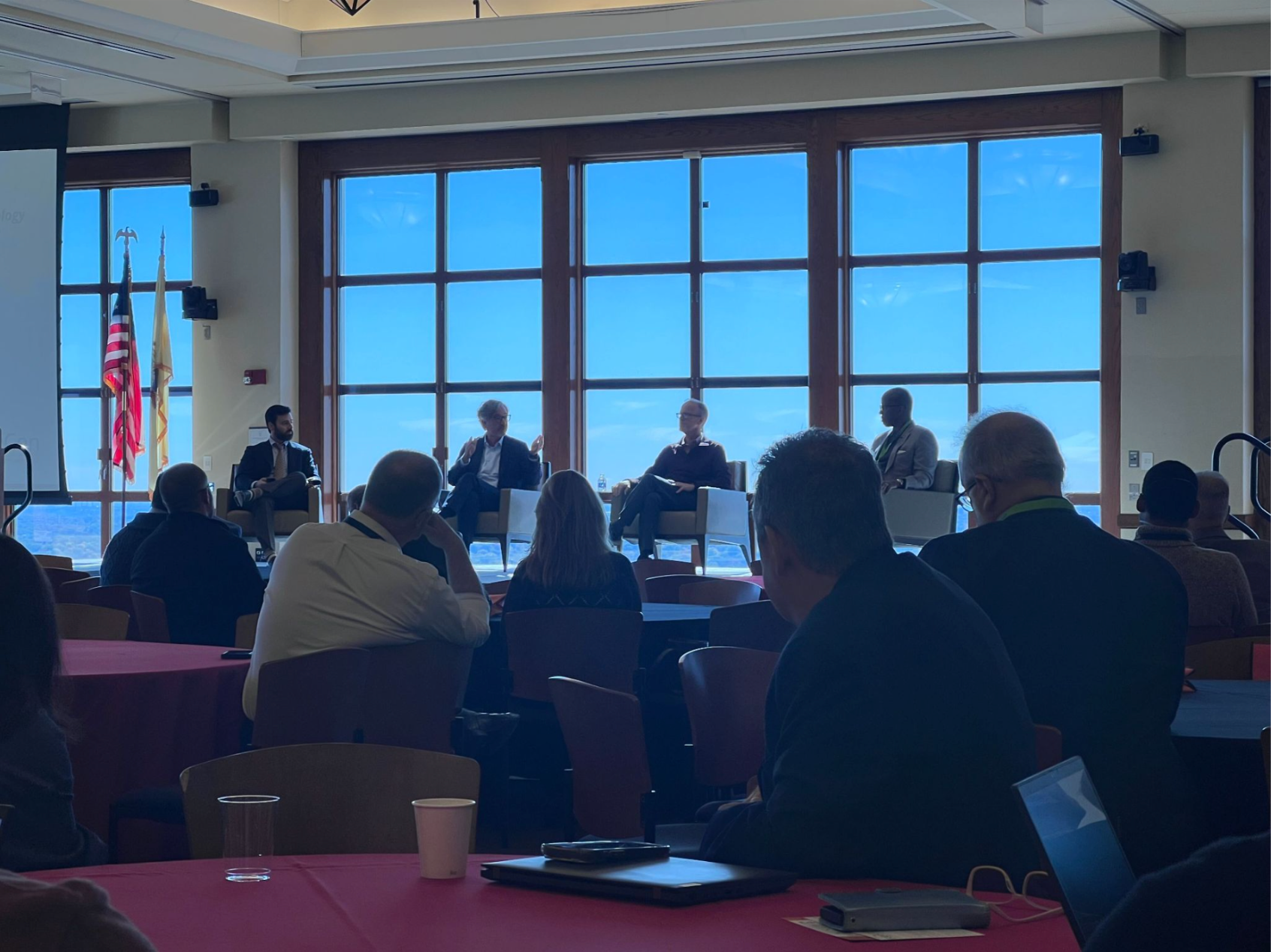
[Photo caption: The NJEDge Edge Con Keynote Panel. Pictured left to right: Adam Scarzafava (moderator); Brett Reinert (Director, Strategic Research, EAB); J. Michael Gower (Chief Financial Officer & University Treasurer, Rutgers, The State University of New Jersey); Keith W. “Mac” McIntosh, Ed.D. (Vice President and Chief Information Officer, University of Richmond)]
Warehouses and Theatres, Revisited: Governing What Your AI Knows
Presented by Robert J. Clougherty, AI Lead, Edge
What does AI have to do with theatres? A lot, actually. When you think of a theatre, the most prominent feature is, of course, the stage. But there are also the backstage areas, the dressing rooms, and even storage areas where additional props and costumes might be stored. All those areas might be really messy, but from an audience perspective, viewers just see what is presented on the stage.
In the same way, Clougherty argues that we should curate the data that AI has access to, rather than letting it access all the messy data in our data warehouses. Why? Because most of the time, you don’t actually need AI to access all of that data. Consider documents within a university that are revised regularly: student handbooks, employee handbooks, branding guidelines, and more. Does AI really need access to a decade’s worth of these documents, or perhaps only the most recent one? In most cases, the latest version can be placed on the “main stage,” and older versions can be stored “backstage” in an archive for archival purposes, but not exposed to the AI. This prevents the AI from providing outdated information as policies change over time. The stage provides the curated, up-to-date information for the AI to reference.
Clougherty also proposes documenting specific policy decisions to capture institutional knowledge. For example, if your network engineer knows that the network needs to be configured a specific way, then it is likely worth documenting for the future. Also worth documenting alongside it: who “owns” the policy, the policy’s effective and expiration dates, and the respective audience. Documenting these policy decisions effectively will help the AI flag them later as needed.
Takeaway: Don’t just point your AI to your entire data warehouse. Instead, curate the information your AI is using to ensure it is referencing the most up-to-date information.
READ A RELATED BLOG POST | ‘Master Your Course Creation (Even If You’re an Accidental Instructional Designer’
Presidential AI Task Force: Architecting Intelligence for Equity
Presented by Jill C. Anderson, Vice President, Development & Alumni Engagement, Moravian University
At Moravian University, they had a familiar problem. As in most organizations, some people were using AI effectively, some weren’t, and still others weren’t using it at all. It was like the wild west, where it was unclear what AI tools were available or what the risks were of using personal or free versions of AI tools.
The University President stepped in to create an AI Task Force whose mission was to “explore and integrate AI technologies across all university areas, with a mandate to enhance educational outcomes, streamline administrative processes, and foster innovative academic programming while ensuring AI’s ethical and responsible use.” It’s quite a notable mission! Surprisingly, they were able to go from charter to board approval in a little over a year’s time. That’s fast for higher education, where often things move at a glacial pace. How did they do it?
One of their biggest innovations was in how they organized themselves. There were 14 university units represented in five subcommittees, each with its own chair and focus areas. In other words, every unit within the university (academic affairs, student life, administration, etc.) had a seat at the table. And not only that, they deliberately staffed each committee with people outside of the relevant units to bring in an external perspective, even though they acknowledged that progress would be slower. It’s one thing to value diversity, but quite another to deliberately organize committees to embrace diverse perspectives, even if it means a longer timeline.
Here are a few other innovations they shared:
- They provisioned secure AI access for everyone. Each user had access to the same library of AI tools.
- They listened to the university community about why they were reluctant to use AI. They uncovered fears of job replacement (Will this tool do my job?), lack of education and understanding about AI, skepticism due to previously failed tech initiatives, and even ethical concerns (bias, privacy, integrity, and access).
- They collaborated and published guidelines for ethical AI use and reviewed those guidelines against every new AI implementation. Those guidelines were also circulated for stakeholder input, giving everyone a voice in the guidelines, including student government.
- They encouraged peer-to-peer learning by incentivizing early AI adopters in as many departments as possible, so that everyone felt like they had someone approachable that they could reach out to. They also had a group of faculty facilitators who led AI learning communities.
- They created a shared AI knowledge base, including 20+ documented best practices, plus a library of AI literacy modules and use cases.
Takeaway: While leadership can and should set company-wide directives, the implementation of those directives should be left to a diverse array of stakeholders. Giving everyone a voice at the table makes them feel like they are part of the process and helps them understand the trade-offs that were made.
It reminds me of my time working at a university as we transitioned to a new learning management system. Students and faculty representatives were both involved in the process, and it ended up being critical to the successful adoption of the new system, as these representatives could see very clearly what features each system could and could not provide. Having that exposure early on ensured that both groups focused on adapting to the new system rather than second-guessing the decision and wondering if another platform would have better suited their needs. Diverse perspectives help you catch issues early on and address them proactively, as well as streamlining adoption later on.
LEARN HOW TO MOVE TO A NEW LMS | ‘Migrate From Moodle™ and Accelerate Growth With Strategic Change Management’
Keynote Panel
Participants: Brett Reinert (Director, Strategic Research, EAB); J. Michael Gower (Chief Financial Officer & University Treasurer, Rutgers, The State University of New Jersey); Keith W. “Mac” McIntosh, Ed.D. (Vice President and Chief Information Officer, University of Richmond)
The keynote panel discussion centered around how Finance and IT can work strategically to push forward the university’s strategic initiatives. One takeaway focused on centralizing expenditures as much as possible. Rather than individual units or schools budgeting for technology or IT expenditure, “Mac” from the University of Richmond advocated for centralizing those expenses to lower costs and reduce redundancy. For instance, using one central accounting system instead of separate individual ones at each school.
Personally, I experienced this at Rutgers University when I worked there many years ago. At the time, several schools each paid for their own learning platforms, for a total of five learning platforms across the entire university. Near the end of my time there, the university ended up consolidating to one, saving the university money in contracts, maintenance, IT, and faculty support. Centralizing resources and services often saves money and improves efficiency.
Takeaway: Consider areas where your organization may be duplicating effort and try to brainstorm ways to eliminate that duplication. Are there tools or best practices that can be shared across departments to help everyone work more efficiently?
Agentic AI Security (Agent Security, Risk, and Compliance)
Presented by Amad Sheikh, CISO, University of Delaware
Imagine that you have been experimenting with AI to the point where you created an agent capable of working autonomously. Maybe you created a chat bot that can send relevant public-facing information to employees. Or an agent that works with other agents to confirm students have met all their graduation requirements, each agent in charge of one requirement. Now imagine the chat bot leaks internal data to an unauthorized individual. Or the agent makes a mistake and confirms that all students, even first-year students, have met all their graduation requirements. Who takes ownership of those mistakes, and how can you prevent them to begin with?
In this session, Sheikh proposed that security and governance are the top challenges for widespread generative AI deployment. More and more, he argued, agent-to-agent communication is becoming the norm, without any human intervention (i.e., no human-in-the-loop). He referenced the OWASP Top 10 for Agentic Applications for 2026 whitepaper, which describes the top 10 security risks for agentic AI applications. To name a few:
Agent Goal Hijack, where hidden instructions tell the AI to ignore its original goal/intent and instead execute new, hidden instructions.
- Identity & Privilege Abuse, where agents receive broad permissions and nearly unlimited access to all systems and data.
- Cascading Failures, where a single prompt injection that compromises a single agent corrupts other agents at lightning speed.
- Rogue Agents, where misaligned or compromised agents intentionally work against organizational goals. They can operate (or appear to operate) perfectly well until a specific trigger point or threshold is met.
The bad news is that these risks are real. The good news is that they can be mitigated, in many cases, by following MAESTRO (Multi-Agent Environment, Security, Threat, Risk, and Outcome), “a novel threat modeling framework designed specifically for the unique challenges of Agentic AI.”
A few concrete tips shared by Sheikh:
- For any security keys or tokens given to agents, tie them to real users to ensure a real user “owns” the credentials and it becomes easier to audit who triggered certain actions and keep everyone more accountable for their agents.
- Lock down your intent for each agent. What specific action should the agent be performing? In what context?
- Give agents the least privilege necessary to perform their task. For example, an agent that simply looks up data probably only needs “read” access (to read existing data) and not “write” access (to insert new records) into a database.
Takeaway: At the end of the day, any agent you create should have alignment of three key areas: permissions (what an agent CAN do), intent (what an agent SHOULD do), and behavior (what an agent ACTUALLY does). When these align, you have a clearly defined scope for each agent and also limited the scope of what any individual agent can and should do. By doing so, you reduce the chances that someone can hijack an agent or that an agent accesses unauthorized information.
RELATED READING | ‘Understanding PHP2Shell: How Open LMS Responded and Protected Client Data’
Cybersecurity 2030: Moving Towards a Career-Ready Program in the AI Era
Presented by John Agar, Academic Specialist - Computer Science, Union College of Union County, NJ; Quba Raza, Academic Specialist - Cybersecurity, Union College of Union County, NJ
Are today’s students prepared for the cybersecurity threats of today and tomorrow? Probably not, argue John Agar and Quba Raza from Union College of Union County. In their session, they outlined how they built a new cybersecurity program at the college from the ground up.
They developed four entirely new courses in information security management, cloud essentials, network security, and AI security. In existing courses, they also integrated cybersecurity- and cloud-related topics. In doing so, they are equipping the next generation of students for the cybersecurity threats of tomorrow.
It was also interesting to hear about how they moved beyond just their department to develop this program. For example, they are allowing students to participate in research projects, build team projects, present at conferences, and even share findings through community digital safety workshops. By participating in these research initiatives, students leave with a portfolio of work they can show to a future employer or transfer school if they choose to further their education.
John also pointed out that he has benefited from training and development resources provided by higher education consortiums such as the NJ Council of Community Colleges (NJCCC) and the National Applied AI Consortium (NAAIC). They have provided collaboration opportunities with other NJ schools as well as training opportunities from Google, Microsoft, and Amazon. Furthermore, their institution, Union College of Union County, is participating in a mentorship program listed on the NAAIC website, where they receive comprehensive program development resources to help them launch AI-related education programs.
Takeaway: When developing training programs, be sure to look beyond your immediate department or team. You never know where you might find communities that can help.
Final Thoughts
Overall, it was interesting to listen to the conversations about AI and its impact on higher education. I look forward to seeing future developments when it comes to managing the data that AI has access to, promoting responsible AI usage across an organization, proper governance of AI agents, and preparing the next generation of students with the AI skills they need.
Ready to explore more about AI? Check out the September session of our monthly Open Office Hours, where we reviewed all of our AI features within Open LMS! You can find all our session recordings by signing up for Open LMS Academy, completely free! Then take a virtual tour or request a demo of Open LMS and learn how we can support learning at your higher education institution.

Discover our solutions

