Customized Learning, Reimagined: What’s New in Open LMS’s Personalized Learning Designer
The latest updates to Open LMS’s exclusive Personalized Learning Designer (PLD) include new AI-driven enhancements, improved scalability, and better rule management, making it easier than ever to automate meaningful interventions without adding administrative burden. The result? Personalization that actually saves time while improving learner outcomes. Read on to learn how the newest PLD upgrades can help you elevate your learning programs.
READ MORE | ‘Seamless Integrations, Seamless Transition: How Open LMS Works With Your Existing Tech Stack’

AI-Recommended Content

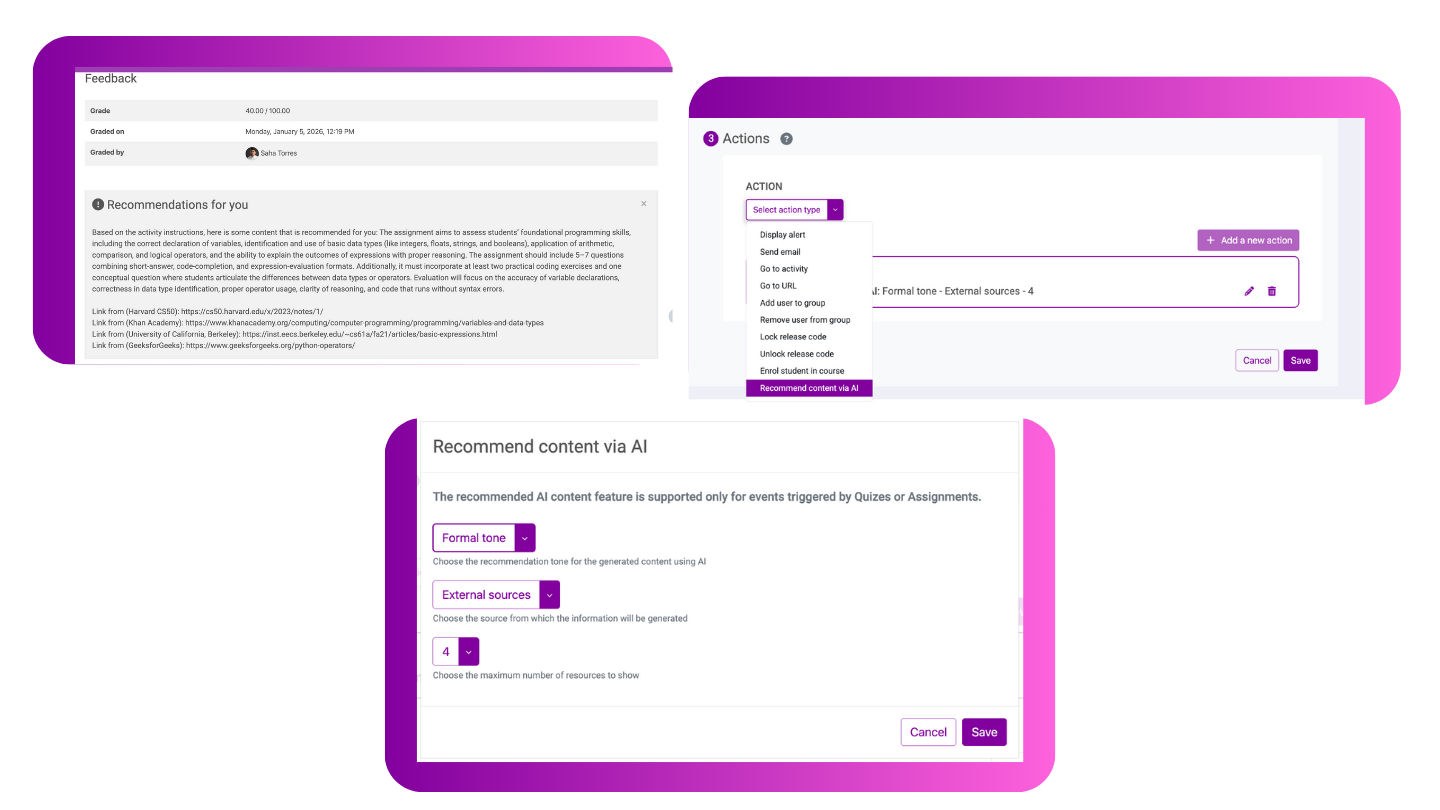
One of the most impactful enhancements to PLD is AI-recommended content, a new PLD action designed to help learners close knowledge gaps at precisely the right moment. Available for assignments and quizzes, this feature enables instructors to automatically deliver personalized learning recommendations based on the grading conditions they define, without any additional manual follow-up.
Once an assignment or quiz is graded, PLD analyzes the activity’s instructions or questions and generates tailored recommendations to support learner improvement. Using AI, the system can surface relevant resources from within the course or from trusted external sources, helping learners understand where they went wrong and what to review next. These recommendations appear directly below the learner’s standard activity feedback, making guidance timely, contextual, and easy to act on.
From a setup perspective, the process is straightforward. Instructors simply create a PLD rule triggered by the “Activity graded” event, apply grade-based conditions (such as scores below a certain threshold or within a specific range), and select the “Recommend content via AI” action. The action can be customized by tone, content source, and the maximum number of resources displayed.
This enhancement addresses a long-standing pain point for instructors: providing individualized feedback at scale. Instead of manually reviewing results and sharing follow-up resources, AI-recommended content automatically ensures every learner receives targeted guidance.
DOWNLOAD THIS EBOOK TO DISCOVER HOW AI IMPACTS L&D | ‘Artificial Intelligence and Learning Management: The Impact of AI On eLearning Programs’
AI-Powered Rule Creation: Making Automation Easier for Everyone
The AI-assisted rule creation enhancement helps users move from idea to execution faster by reducing the complexity of building automation logic.
Instead of manually configuring every condition and action, users can rely on AI guidance to structure rules more intuitively. This is especially valuable for instructors and administrators who understand the learning outcome they want but don’t want to wrestle with the technical setup.
This PLD enhancement elevates or minimizes:
- Uncertainties about how to structure effective rules
- The steep learning curve for first-time PLD users
- Hours spent troubleshooting automation logic
Enhanced AI support makes PLD more approachable, encouraging broader adoption of the tool and more consistent use of personalization across courses.
Reusable Rules: Personalization Without Repetition
Previously, creating PLD rules often meant rebuilding the same automation from scratch in every course. The updated PLD now allows rules to exist as standalone, reusable activities.
Learning teams can back up, restore, and reuse rules across multiple courses or environments, dramatically reducing setup time and protecting valuable work.
This enhancement helps users avoid:
- Duplicating automation across dozens or hundreds of courses
- Losing carefully built rules during course resets or migrations
- Inconsistent learner experiences across programs
HANDPICKED FOR YOU | ‘What’s the Real ROI of AI in Your LMS? How Open LMS Drives Top Results’
Site-Level PLD: Consistency Across the Organization
Program consistency is essential to achieving your organization’s learning goals. That’s why PLD can now be deployed at the site level, enabling automation that supports learners across the entire LMS—not just within individual courses.
This opens the door to organization-wide use cases, such as:
- Automated nudges for disengaged learners
- Consistent deadline reminders
- Standardized support messages tied to learner behavior
Site-level PLD ensures learners receive timely, relevant support, regardless of where or how they’re learning. This upgrade reduces your organization’s reliance on manual instructor follow-ups while increasing visibility into how personalization is applied at scale.
A Smoother Path Forward for Existing PLD Users
Open LMS understands that upgrades can raise concerns, especially when automation is already in place. That’s why the new PLD retains its legacy interface and logic, eliminating the learning curve for users who are familiar with previous iterations of the tool.
Automatic migration links appear when you add a new PLD module to a course that already contains legacy PLD rules, making it easy for you to import the rules you want to retain. After you complete an import and establish your new PLD rules, your original settings are disabled but not deleted.
Open LMS ensures that existing PLD users can confidently transition to the latest version of the tool, knowing their automation logic is backed up, protected, and easier to manage going forward.
Old PLD vs. New PLD: What’s Changed?
The table below provides a concise overview of the differences between the legacy and upgraded versions of PLD.
Feature | Legacy PLD | Upgraded PLD |
|---|---|---|
Content recommendation | Limited availability | AI-powered recommendations for assignments and quizzes |
Rule creation | Manual setup required | AI-assisted rule creation |
Ease of use | Powerful but complex | Intuitive and accessible |
Rule reuse | Limited, course-specific | Reusable, standalone PLD activities |
Scalability | Course-level only | Course-level and site-level deployment |
These updates help instructors reduce the need to manually follow up with learners, enabling students to receive timely feedback and support. For administrators, the PLD enhancements offer scalable automation with governance and consistency.
By combining AI-driven guidance with flexible automation, PLD helps organizations move from aspirational personalization to practical, everyday impact.
The latest PLD enhancements remove friction without adding complexity. With smarter rule creation, reusable automation, and site-level scalability, Open LMS is making personalized learning easier to implement and sustain.
When supported by the right tools, one well-designed rule can now help thousands of learners—automatically, consistently, and effectively.
Organizations and institutions around the world leverage Open LMS’s innovative solutions, including the Personalized Learning Designer, to streamline their L&D operations. Take a tour of the platform or request a demo today to learn how Open LMS can help you achieve your learning goals.