Is Your LMS Ready for the Next Five Years of Higher Ed?
Higher education is navigating one of the most disruptive periods in its history. Enrollment patterns are shifting, delivery models are evolving, and artificial intelligence is changing how learning content is created, discovered, and evaluated. Yet many institutions are still choosing learning management systems based on short-term feature sets rather than long-term readiness.
The real question you should be asking isn’t, “What can our LMS do today?” It’s, “Will this platform still support our institution five years from now?” An LMS that’s ready for the future of higher education must be resilient, flexible, and built for adaptability in an AI-driven world.
READ MORE FROM THE BLOG | ‘Why You Need Open LMS: A Smarter, Stronger LMS for 2026’

Why Feature-First LMS Decisions Don’t Age Well
Although all the bells and whistles of the modern LMS are undoubtedly helpful for many instructors and students, technology changes so rapidly that what appears to be cutting-edge today may be outdated tomorrow. If your institution selects its LMS based solely on a checklist of current features, it runs the risk of underestimating how quickly those features (and your needs) will evolve.
Higher education doesn’t operate on a two-year software cycle. LMS decisions typically last a decade or more. Platforms that lack adaptability could force you into costly migrations, workarounds, or vendor dependency long before your contract ends.
How Can You Tell If Your LMS Is Future-Ready?
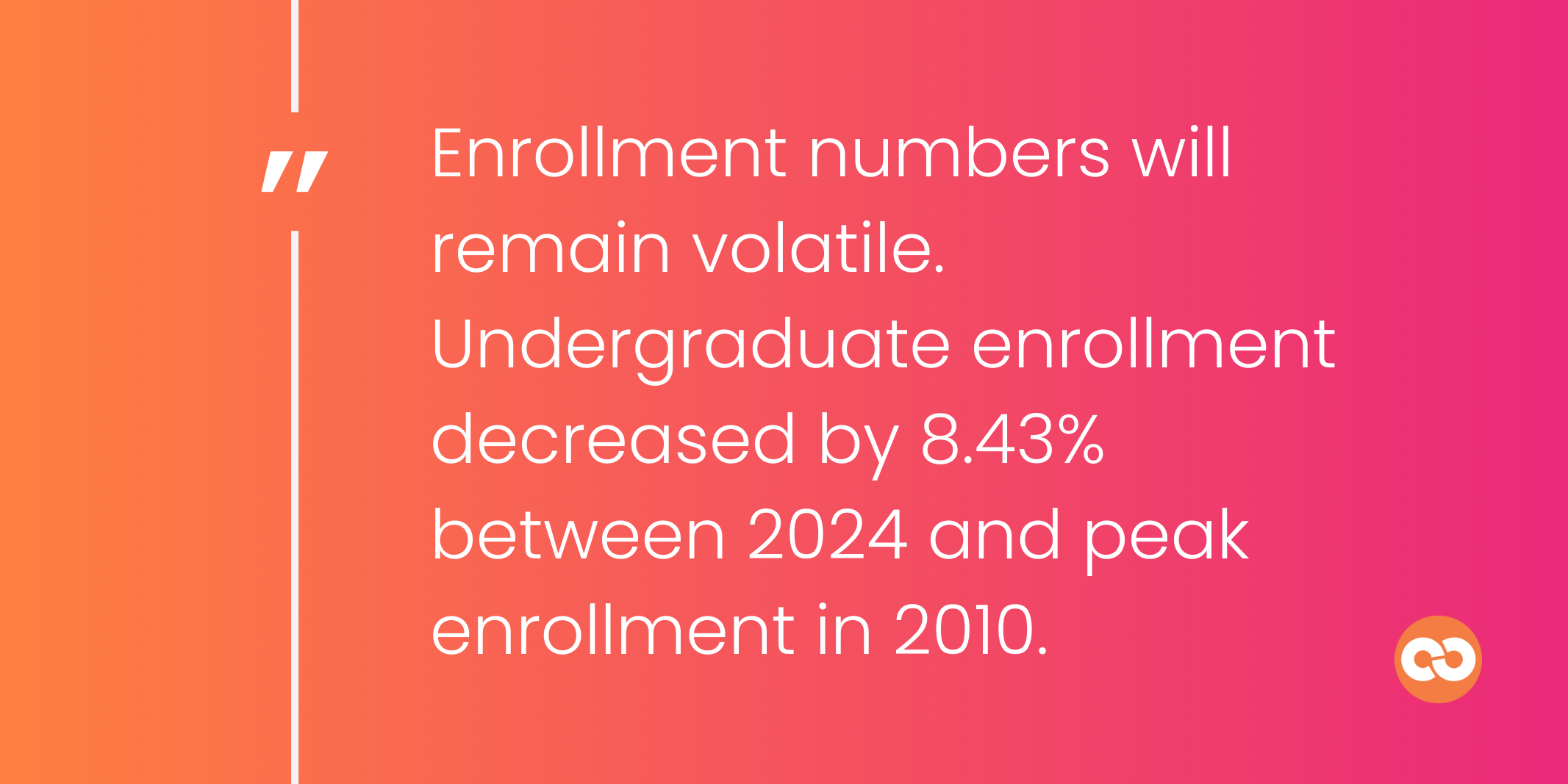
It’s important to understand what’s in store for the future of higher education. For example, enrollment numbers will remain volatile. While recent U.S. data found that current undergraduate enrollment grew 3.2% between the Spring 2025 and Spring 2024 educational terms, another study found that undergraduate enrollment had decreased by 8.43% between 2024 and its peak in 2010.
Nontraditional learners (adults over the age of 24 with work experience, as well as those with veteran or disability statuses) are also expected to equal or surpass the number of traditional students who enroll at higher education institutions in the U.S. According to the Western Interstate Commission for Higher Education, the number of high school graduates (and therefore the number of traditional undergraduate enrollments) peaked in 2025 and will steadily decline through 2041. This leaves nontraditional learners to fill in the enrollment gap, meaning your higher education institution must be prepared to respond to these students’ vastly different academic and training needs.
Additionally, the following are expected to continue impacting higher education over the next five years:
- Increased regulatory, accreditation, and reporting requirements
- Hybrid and online learning as the default, not the exception
- AI-assisted course design, assessment, and learner support
- Growing reliance on interconnected ecosystems (SIS, analytics, identity, content tools)
An LMS must evolve alongside these realities, rather than resisting them. Asking yourself (and your L&D leaders) the right questions will help you assess the longevity and adaptability of your learning platform so you can ensure you’re making a great investment in your institution’s future.
DOWNLOAD THE EBOOK TO ENSURE YOU’RE FUTURE-READY | ‘How 5 Trending Technologies Are Defining the Future of Higher Education’
1) Can Your LMS Withstand Disruption?
Downtime isn’t a minor inconvenience. LMS outages can derail courses, assessments, and upend institutional trust for your students and faculty. Disruptions also create reputational and operational risk, which means more headaches for you and your leadership team.
A future-ready LMS will have:
- Proven uptime and redundancy
- Clear incident communication and accountability
- Regular patching and security updates
- A vendor that treats reliability as mission-critical
If your learning platform isn’t resilient or can’t recover quickly during unexpected disruptions today, it’s unlikely to reduce your risks over the next five years.
2) Can Your LMS Adapt Without Starting Over?
Higher education institutions must balance innovation with stability. That means you need the tools necessary to support updated pedagogies, evolving credential requirements, and upgraded delivery models without requiring constant re-platforming.
A flexible LMS enables institutions to:
- Integrate easily with SIS, HR, analytics, and accessibility tools
- Support faculty autonomy without fragmentation
- Scale programs without increasing complexity
- Avoid vendor lock-in that limits future choices
3) Can Your LMS Work Well With Evolving AI-Assisted Features?
AI is reshaping how learners and administrators find information. Future-ready LMS platforms must support structured, interoperable data that can power AI-assisted discovery, not just flashy AI features. The question you need to be asking isn’t whether your LMS has AI. It’s whether your learning platform is designed to work with AI over time.
This is one of the trickier questions to assess, since new AI capabilities and features are being developed and tested constantly. A good indicator that your learning platform can play well with evolving technology is its level of flexibility and the degree to which it can be customized to meet your needs. Flexible, configurable platforms are more likely to adapt quickly to AI enhancements and new feature rollouts.
LEARN MORE | ‘What’s the Real ROI of AI in Your LMS? How Open LMS Drives Top Results’
The Cost of Standing Still
You need to assess your LMS carefully before committing to a major migration. It’s entirely possible that your current solution will withstand the many evolutions anticipated in higher education over the next half-decade. However, choosing to delay or avoid AI implementation or LMS modernization could leave you facing:
- Rising technical and maintenance costs
- Increasing integration complexity
- Reduced agility in responding to change
- Higher long-term migration costs as your system ages
The longer an LMS remains misaligned with institutional strategy, the more expensive—and disruptive—change becomes.
Use this checklist to assess whether your LMS is prepared for the next five years of higher education:
Is Your LMS Ready for the Next Five Years of Higher Ed?
- Demonstrated reliability and uptime
- Transparent security and patching practices
- Flexible architecture with open integrations
- Support for AI-driven discovery and insights
- Reduced vendor lock-in and clear exit paths
- Proven experience supporting higher ed at scale
Looking Ahead
The LMS you choose today will shape teaching, learning, and institutional agility for years to come. As higher education continues to evolve, platforms built for transparency, adaptability, and resilience will define success.
The real question isn’t whether your LMS works today. It’s whether it’s ready for what comes next.
Open LMS’s enterprise-grade support, flexibility, and scalability ensures your institution can adapt to whatever changes lie ahead. Take a virtual tour or request a demo today to learn how we can help you stay resilient and innovative now and in the future.